SQL Server health checks
A structured review of your SQL Server estate, with findings explained in plain English and a prioritised improvement plan.
- Configuration and capacity review
- Backup, job and integrity checks
- Performance and resilience risks
Optimising SQL Server performance, one query at a time.
Practical database expertise for businesses that depend on SQL Server. From a focused health check to ongoing remote DBA support, DBTECH helps you understand the risks and make the right improvements.
25+ years of hands-on experience · Based in Sheffield · Remote delivery
Address an immediate issue, plan your next migration or put dependable database support in place. Each engagement starts with your systems, priorities and business requirements.
A structured review of your SQL Server estate, with findings explained in plain English and a prioritised improvement plan.
Investigate slow queries, blocking and resource pressure. Focus changes on the bottlenecks that affect your applications.
Plan and deliver a move that fits your workload, from SQL Server version upgrades to Azure SQL and Azure virtual machines.
Build your recovery approach around how much downtime and data loss your business can tolerate.
Ongoing SQL Server expertise without a full-time hire. Agree the scope, support hours and responsibilities around your needs.
Extend your managed services offering with specialist SQL Server support for client projects and technical escalations.
When a client needs deeper database expertise, DBTECH can work alongside your team. Agree the delivery model, communication and responsibilities before work begins.
Start a partner conversation ↗Discuss the environment, symptoms and business impact. Agree access requirements and a scope before work starts.
Investigate the cause, explain the options and agree changes. Plan validation and rollback around your operating requirements.
Document findings and changes, share recommendations and agree any follow-up support your team needs.
DBTECH Solutions Ltd was founded by Richard Morrison in November 2011. Richard brings more than 25 years of SQL Server DBA and development experience across public and private sector environments.
Work directly with a consultant who understands database administration, query performance, data integration and the operational demands behind them.
Richard’s professional experience includes work with Hiscox, the NHS, Pearson, Royal Mail, British Gas, Unilever, Bet365 and Yorcard. These references describe professional experience, not endorsements or current client relationships.
SQL Server · T-SQL · AlwaysOn · SSIS · SSRS · SSAS · Azure
Tell us what you’re working on, what’s causing concern and the timescale you have in mind. We can then discuss a suitable next step.
rich@dbtech-solutions.comConnect with Richard on LinkedIn ↗
For MSP enquiries, include the type of support you need and whether the requirement is project-based or ongoing.
SQL SERVER PERFORMANCE TUNING
Slow queries, blocking or unexplained CPU spikes? Investigate the workload, understand the cause and agree practical changes based on the evidence.
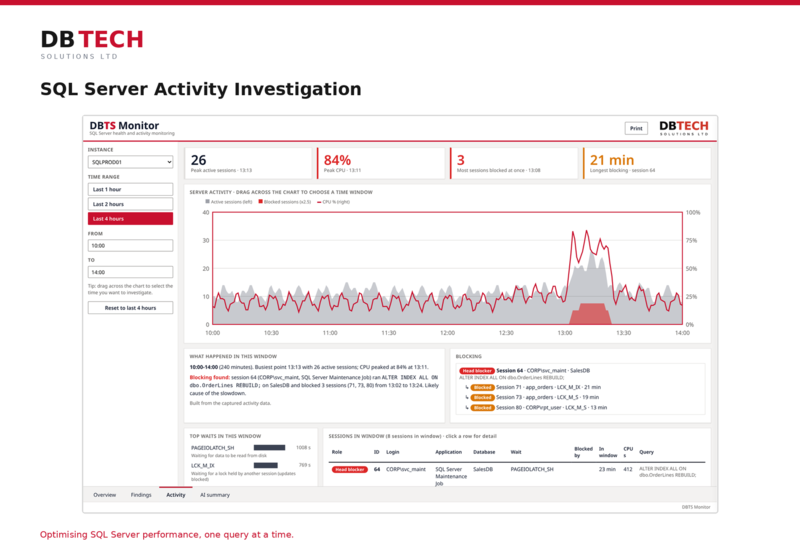
Click the screen to read the original full-size activity view ↗
Understand the workload and context.
Prioritise the issues affecting users.
Check results against an agreed baseline.
Know what to change and why.
PERFORMANCE INVESTIGATION
A spike is a starting point, not a diagnosis. Look at the same time window across sessions, CPU, waits and blocking to build a clearer picture.
Activity view: CPU, sessions, blocking and waits in one investigation window.
A PRACTICAL TUNING PROCESS
Scope the investigation around your environment, access and business priorities. Agree changes and validation before applying them.
Review symptoms, timings and workload patterns. Confirm what evidence is available through Query Store, DMVs, execution plans or Extended Events.
Examine expensive queries, waits, blocking, indexing and configuration. Explain the likely causes and prioritise the options.
Agree a controlled change, test it against comparable conditions and document the outcome, trade-offs and rollback plan.
WHAT WE CAN REVIEW
Plan choices, estimates, expensive operators and query patterns.
Long transactions, blocking chains, deadlocks and workload contention.
Index suitability, statistics quality and the cost of changes.
CPU, memory and storage evidence in the context of the workload.
Memory, parallelism and tempdb settings against environment needs.
Prioritised recommendations, validation notes and a walkthrough.
LET’S FIND THE CAUSE
Describe the symptoms, SQL Server version and business impact. I’ll reply personally to discuss a suitable investigation. Scope, access and delivery are agreed before work starts.
 Print